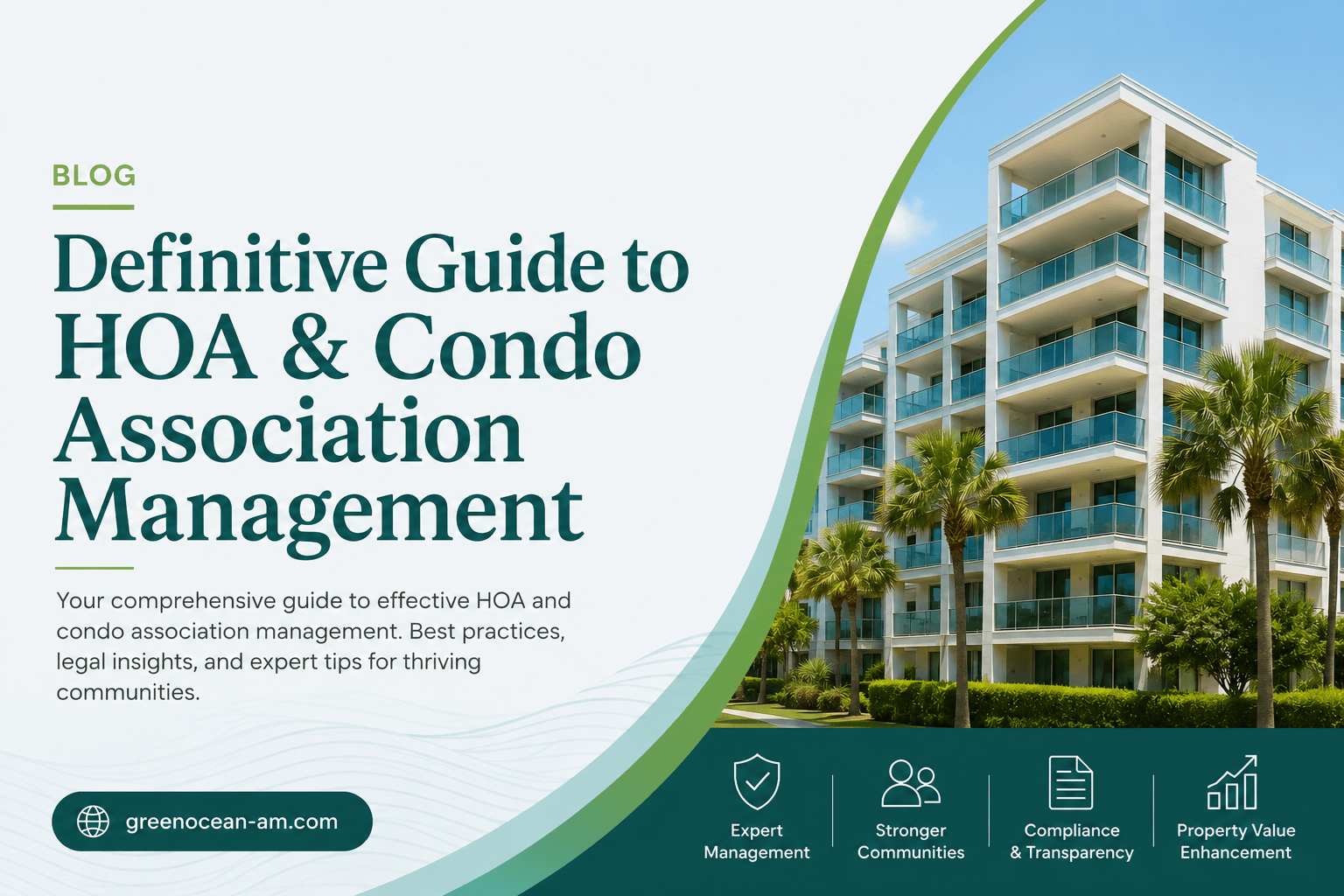
Serving on a condo or HOA board is one of the most demanding volunteer jobs in any community. Boards juggle budgets, aging building systems, resident expectations, unreliable vendors, legal compliance, reserve planning, and constant turnover, usually without formal training.
This HOA management guide was written to make that work easier. It’s a practical, board-focused resource for Massachusetts condo association trustees and HOA board members. It helps them understand their responsibilities, run their community well, and know when professional help makes sense.
By the end of this guide, you’ll understand what HOA and condo management involves. You’ll know how to handle finances and reserves, plan maintenance, and manage vendors.
You’ll also see how governance and Massachusetts condominium law fit together, plus the clear signals that tell a board it’s time to bring in a professional partner. Think of it as a complete reference you can return to throughout your term.
What Is HOA and Condo Association Management?
HOA and condo association management is the day-to-day administration of a community association’s operations. This covers its money, its buildings and grounds, its rules, its records, and its relationships with owners and vendors.
A single landlord manages a property they own. An association, by contrast, is a collective, owned and governed by the homeowners themselves through an elected board.
That distinction matters. Managing a physical property is about maximizing one owner’s asset. Managing a community association is about serving many owners fairly, protecting shared assets, and following governing documents and state law. The job is part operations, part finance, part diplomacy.
A complete hoa management guide should cover the core responsibilities every association carries, whether handled by volunteers or a professional manager:
- Finances — budgets, common charges, reporting, and reserves.
- Maintenance — preventive upkeep, repairs, and capital projects.
- Governance — bylaws, rules, meetings, and decisions.
- Communication — keeping owners informed and responsive.
- Vendor oversight — hiring, scheduling, and supervising contractors.
- Record keeping — minutes, contracts, financials, and documents.
- Compliance — aligning operations with governing documents and Massachusetts law.
- Resident support — handling requests, complaints, and onboarding.
When these functions run smoothly, owners barely notice — which is the point. When they break down, problems compound quickly.
HOA vs. Condo Association Management: What’s the Difference?
The terms are often used interchangeably, and the fundamentals overlap heavily: both involve budgets, reserves, governance, maintenance, and communication. But there are practical differences in what each typically focuses on.
Condo associations usually own and maintain shared building systems and structural components: roofs, foundations, siding, hallways, elevators, common plumbing and electrical, and common areas. They carry a master insurance policy, maintain reserves for major building components, and operate under a master deed, declaration of trust, and bylaws.
HOAs more often govern communities of single-family homes or townhomes. Their shared responsibilities may center on private roads, landscaping, amenities, stormwater systems, and architectural rules. Individual owners typically maintain more of their own structures.
The simplest way to think about it: condo associations tend to manage shared buildings, while HOAs tend to manage shared land, amenities, and standards. Most associations in Greater Boston are condominium associations, which is why building-systems expertise and reserve planning matter so much locally.
What Does an Association Manager Do?
An association manager runs the day-to-day operations of a community association on behalf of the board. They prepare budgets and financial reports, coordinate maintenance and vendors, communicate with residents, organize records, and support board meetings. This lets the board focus on decisions rather than logistics.
In practice, the role is broad. A professional association manager typically handles:
- Board meeting support — agendas, packets, reports, and action items.
- Budgeting and financial reporting — annual budgets and monthly statements.
- Assessment collection coordination — issuing common charges and managing collections.
- Maintenance coordination — dispatching vendors and tracking work orders.
- Vendor management — bids, insurance verification, scheduling, invoice review.
- Resident communication — answering questions, sending notices, managing the portal.
- Rule enforcement support — documenting violations and applying policy consistently.
- Document organization — governing documents, contracts, and records.
- Insurance coordination support — gathering certificates and routing claims.
- Emergency response coordination — mobilizing vendors during urgent events.
- Long-term planning — supporting reserve studies and capital projects.
One principle is essential: the manager supports the board, but the board governs. Managers execute, advise, and maintain systems; the board sets policy, approves budgets, and makes fiduciary decisions. For a deeper look at the role, see these condominium association manager responsibilities.
Board Responsibilities vs. Management Company Responsibilities
A frequent source of friction is who does what. The board holds legal authority and fiduciary duty; the management company helps carry out the board’s decisions and runs operations.
| Board Responsibilities | Association Manager / Management Company |
|---|---|
| Set policy and approve the annual budget | Prepare the draft budget and financial reports |
| Make governance and fiduciary decisions | Provide data and options to inform decisions |
| Approve major contracts and expenditures | Solicit bids, vet vendors, present recommendations |
| Adopt and interpret rules and regulations | Apply rules consistently and document enforcement |
| Set assessments and reserve funding levels | Bill assessments and manage collections |
| Hold and run board/owner meetings | Prepare agendas, packets, minutes, and notices |
| Engage legal counsel and insurance professionals | Coordinate documents and route matters |
| Provide direction and oversight | Maintain systems, records, and daily operations |
Fiduciary responsibility, in plain terms, means board members must act in the association’s best interest: honestly, prudently, and within the governing documents and law. A management company reduces the operational burden and gives the board better information. It does not, however, replace the board’s duty to govern.
Financial Management for HOA and Condo Associations
Financial management is the backbone of a healthy association. Owners may forgive a slow repair, but they rarely forgive a surprise special assessment or murky books. Strong, transparent finances build trust — and trust is what keeps boards stable.
Effective association financial management includes:
- Annual budgets that fund real operating costs and adequate reserve contributions.
- Monthly financial reports — balance sheet, budget variance, and delinquency reports.
- Operating funds vs. reserve funds, kept separate.
- Assessments / common charges set to match the budget.
- A clear collections process applied consistently.
- Invoice approvals with defined authority and documentation.
- Bank reconciliations every month.
- Financial transparency so owners can see where money goes.
- A monthly board review cadence.
- Proactive reserve funding to avoid surprise special assessments.
Board Financial Checklist
- Approve a budget that funds operating costs and reserves
- Review monthly statements within ~30 days of month-end
- Keep operating and reserve accounts separate
- Reconcile every bank account monthly
- Follow a written, consistent collections policy
- Require documentation for all invoice approvals
- Track delinquencies and address them early
- Review reserve funding against the reserve study annually
- Share clear financial summaries with owners
Clear financials are how a board earns owner confidence and avoids disputes born of financial confusion.
This is also where professional support pays off. Green Ocean Association Management emphasizes financial transparency and disciplined reporting, so boards always know where the association stands. Learn more about our professional HOA management support.
Reserve Planning and Long-Term Capital Projects
Reserves are the savings an association sets aside for major repairs and replacements. A reserve study inventories these components, estimates their remaining life and replacement cost, and recommends a funding plan so the money is there when the work is due.
Typical reserve components include roofs, siding, elevators, common plumbing and electrical systems, paving, masonry, mechanical systems, decks, and shared common-area elements. Each has a different lifespan, and each fails eventually.
The danger is deferred maintenance. Putting off a repair rarely saves money — it usually multiplies the cost.
A small roof leak ignored for two winters becomes rotted sheathing, interior damage, and mold remediation. Underfunded reserves then force an emergency special assessment. Aligning reserve funding with the building’s real condition is one of the most important things a board can do.
For a real-world look at this process, see our Newton condo reserve planning and roof replacement case study.
Example scenario: A 24-unit Massachusetts condo association has a 20-year-old roof and roughly $90,000 in reserves. A reserve study projects roof replacement in three to five years at about $140,000. Rather than face a sudden $50,000 shortfall, the board raises reserve contributions modestly now and schedules the project. This spreads the cost over time and avoids a painful special assessment. For current professional standards, the Community Associations Institute publishes reserve study guidance.
Maintenance Management Best Practices
Good maintenance is proactive, not reactive. Among the most valuable condo management best practices is shifting from “fix it when it breaks” to a planned program that catches problems early and keeps residents safe.
- Preventive maintenance on a schedule (HVAC, gutters, drains).
- Seasonal inspections of roofs, grounds, and systems.
- Work order tracking so nothing falls through the cracks.
- Emergency repair protocols with after-hours coverage.
- Common-area maintenance kept consistent and documented.
- Building-systems attention — heating, plumbing, electrical, life safety.
- Documentation of every repair.
- Easy resident reporting.
- Prioritizing safety issues above cosmetic ones.
Preventive Maintenance Checklist for Condo Boards
- Inspect roofs and flashing each spring and fall
- Clean gutters and downspouts before winter
- Service heating systems ahead of the cold season
- Check drainage and grading to prevent water intrusion
- Test life-safety systems (alarms, emergency lighting)
- Inspect masonry, walkways, and railings for hazards
- Line up snow and ice management contracts early
- Document every inspection and repair
In Greater Boston, weather drives the calendar. Hard freezes, ice dams, heavy snow loads, and spring thaw stress roofs, gutters, drainage, and heating systems. The region’s older building stock is also less forgiving of neglect. A maintenance program tuned to New England seasons prevents the most expensive and most dangerous failures.
Vendor Management and Contractor Oversight
Associations rely on vendors for nearly everything — landscaping, snow removal, plumbing, roofing, cleaning, and major repairs. Poor vendor management leads to overspending, inconsistent work, and liability exposure.
- Clear scope of work so bids are comparable.
- Competitive bidding for significant projects (typically three bids).
- Insurance verification — current certificates on file before work begins.
- Licensing where applicable.
- Scheduling that minimizes resident disruption.
- Direct communication with a single point of contact.
- Invoice review against the agreed scope.
- Quality control with follow-up and sign-off.
- Avoiding conflicts of interest.
A professional manager brings an established, vetted vendor network and handles this oversight day to day. This is a major reason boards seek condo association management services in Greater Boston. The result is better pricing, properly insured contractors, and work done right.
Governance, Rules, and Board Decision-Making
Governance is simply how the board makes and enforces decisions. Doing it consistently is what keeps an association fair and out of trouble. The framework lives in your governing documents: bylaws (how the association operates), the master deed / declaration (what’s owned in common), and rules and regulations (day-to-day standards).
Sound practices include regular board meetings, accurate minutes, proper voting procedures, and open owner communication. Above all, enforce rules consistently. Selective enforcement — applying a rule to one owner but not another — is one of the fastest ways to create disputes and erode trust.
Boards should review their governing documents regularly and consult qualified Massachusetts legal counsel for any interpretation question. Documents vary widely, and the language in your documents usually controls the outcome.
Massachusetts HOA and Condo Association Regulations
Massachusetts has specific considerations every condo board should understand. The key statutory framework is Massachusetts General Laws Chapter 183A, the state’s condominium statute. Read it at Massachusetts General Laws Chapter 183A, with an overview on the Mass.gov Chapter 183A resource page.
- Governing documents often control the details. Chapter 183A sets the framework, but your master deed, trust, and bylaws frequently govern meeting rules, voting, notices, and board authority.
- Common expenses and assessments, association powers, and owner rights flow from the statute and your documents.
- Records matter — owners generally have rights to inspect association books and records.
Taxes are another area boards overlook. See the IRS homeowners association guidance and the Massachusetts TIR 10-3 on taxation of unincorporated homeowners associations.
Disclaimer: This guide is for general educational purposes only and is not legal, tax, or accounting advice. Boards should consult qualified Massachusetts counsel, a CPA, or other licensed professionals before making legal or financial decisions.
Communication Best Practices for HOA Boards
Most board conflict traces back to communication, not the underlying issue. When owners feel informed, they extend goodwill; when they feel kept in the dark, they assume the worst.
- Clear channels — a portal, email, and posted notices.
- Response-time expectations.
- Regular meeting updates and timely minutes.
- Advance maintenance notices for work affecting residents.
- A reliable way to handle owner questions.
- Handling difficult conversations calmly and consistently.
- Transparency around budget decisions.
- Communicating the “why” behind decisions.
When owners understand the reasoning behind a dues increase or project, resistance drops sharply. For boards that want to educate owners, our HOA and condo association education videos are a useful, shareable resource.
Record Keeping and Documentation
Documentation is what keeps an association functional when boards change — and they always do. The institutional memory of a community shouldn’t live in one volunteer’s inbox.
- Meeting minutes and notices
- Financial reports, budgets, and reserve records
- Vendor contracts and bids
- Insurance documents and certificates
- Maintenance history and inspection reports
- Owner correspondence and complaint logs
- Governing documents and amendments
Good documentation protects board continuity, supports compliance, and defends the board’s decisions if questioned. When a new trustee joins, a well-kept record set is the difference between a smooth transition and months of confusion.
Insurance, Risk, and Liability Considerations
Associations carry real risk, and managing it is part of the job. At a high level, boards should be aware of:
- The master insurance policy covering common elements (per your documents).
- Common areas as a primary source of liability exposure.
- Vendor insurance — never let an uninsured contractor work on the property.
- Certificates of insurance collected and kept current.
- Claims coordination routed promptly to the right professionals.
- Risk reduction through maintenance — many claims are preventable.
Insurance is technical, and policies differ. Boards should review coverage with licensed insurance professionals rather than rely on assumptions.
Self-Managed vs. Professionally Managed Associations
Many small associations start out self-managed. It can work — usually in smaller communities, with simple buildings, engaged volunteers who have time, and no major projects on the horizon. But associations evolve, and self-management often hits a wall. Common signs it’s time to consider professional help:
- Board burnout and difficulty filling seats
- Delayed or reactive maintenance
- Financial confusion or inconsistent reporting
- Rising owner complaints
- Vendor problems and unreliable contractors
- Poor record keeping and lost knowledge
- Unpaid assessments piling up
- Major capital projects approaching
- Inconsistent communication with owners
If several of these sound familiar, you’re not failing — you’re outgrowing the volunteer model. For a balanced comparison, read self-management versus professional HOA management. And if you’d like to talk it through, you can always schedule a board consultation.
How to Manage a Condo Association Step by Step
If you’re learning how to manage a condo association, this framework gives you a clear, repeatable order of operations:
- Review governing documents — know your master deed, trust, and bylaws.
- Define board roles — president, treasurer, secretary.
- Build an annual budget — fund operating costs and reserves.
- Review reserves — get or update a reserve study.
- Create a maintenance calendar — preventive tasks and inspections.
- Establish communication procedures — channels, cadence, response times.
- Organize vendor contracts — scopes, insurance, renewals.
- Track financials monthly — statements, reconciliations, delinquencies.
- Document board decisions — minutes and resolutions.
- Plan long-term projects — sequence capital work against reserves.
- Review insurance and risk — with licensed professionals.
- Decide whether professional management is needed — assess capacity honestly.
Local HOA and Condo Management in Greater Boston
Massachusetts condo communities face distinct local challenges: older and historic buildings, demanding winters, dense neighborhoods, tight parking, aging roofs and masonry, multi-unit triple-deckers and brownstones, and high repair costs. Effective management here requires knowing the building stock, the vendors, and the seasonal rhythms.
Green Ocean serves communities across the region, including Newton HOA management, Cambridge condo association management, Brookline HOA management, Somerville HOA management, South Boston condo association management, and East Boston HOA management.
Local experience means faster vendor response and realistic budgets for local conditions. It also means familiarity with the regulatory environment.
HOA Management Best Practices for Board Members
These condo management best practices apply to nearly every association:
- Keep financials transparent
- Document decisions
- Communicate early, especially before assessments and projects
- Maintain reserves based on a real reserve study
- Inspect common areas regularly
- Enforce rules consistently
- Avoid informal vendor arrangements
- Plan before emergencies happen
- Educate new board members
- Review governing documents annually
For more board-focused tips, browse our HOA board resources.
When Should an HOA Board Hire a Management Company?
There’s no single right answer, but certain triggers tell a board it’s time to seek professional support:
- The association is growing in size or complexity
- The board lacks time to keep up
- Maintenance has become reactive
- Budget issues recur year after year
- Vendors are hard to manage
- Residents complain about communication
- Major capital projects are coming
- Board turnover is high
If your community is hitting these points, professional management can restore stability. This means bringing financial transparency, proactive maintenance, clear communication, vendor coordination, and a customized management plan.
Green Ocean Association Management partners with Greater Boston condo associations and HOA boards to do exactly that. Compare HOA management pricing or schedule a board consultation to talk through your community’s needs.
Frequently Asked Questions About HOA and Condo Association Management
What is HOA management?
HOA management is the professional administration of a community association’s finances, maintenance, governance, vendors, and communication. A manager supports the board with budgeting, reserve planning, repairs, record keeping, and resident requests. The board retains all governance and fiduciary decision-making authority.
What does an association manager do?
An association manager handles day-to-day operations: preparing budgets and financial reports, coordinating maintenance and vendors, communicating with residents, organizing records, and supporting board meetings. This lets the board focus on decisions rather than logistics.
What is the difference between an HOA and a condo association?
Condo associations typically own and maintain shared building systems and structures under a master deed and carry master insurance. HOAs more often govern single-family or townhome communities, focusing on private roads, landscaping, amenities, and architectural standards.
How do you manage a condo association effectively?
- Review your governing documents
- Define board roles
- Build a funded annual budget
- Maintain reserves based on a reserve study
- Follow a maintenance calendar
- Communicate consistently
- Manage vendors with proper scopes and insurance
- Track financials monthly
- Document every decision
What are the most important condo management best practices?
- Keep finances transparent
- Fund reserves properly
- Maintain the property proactively
- Enforce rules consistently
- Communicate early and clearly
- Document decisions
- Use vetted, insured vendors
- Review governing documents annually
Does a Massachusetts condo association need professional management?
Not always. Small, simple associations with engaged volunteers can self-manage. Growing communities, recurring budget problems, deferred maintenance, high turnover, or major capital projects are strong signals that professional management would help.
What financial reports should HOA boards review?
At minimum, a monthly balance sheet, an income-and-expense statement compared to budget, a delinquency/aging report, and bank reconciliations. Reserves should be reviewed against the reserve study at least annually.
How often should a condo association update its reserve plan?
Reserve studies are commonly reviewed every few years and updated sooner after major projects or significant changes in building conditions. Funding should be revisited annually during budgeting to keep pace with real costs.
What should HOA boards look for in a management company?
Look for financial transparency, strong communication, proactive maintenance, a vetted vendor network, relevant local experience, clear reporting, and a management plan customized to your community rather than one-size-fits-all.
When should a self-managed association consider hiring help?
These are the clearest signs it’s time to bring in professional support: volunteers burning out, maintenance falling behind, confusing finances, rising owner complaints, or an approaching major project.
Conclusion
Running a condo or HOA well isn’t about doing everything perfectly. It’s about structure, communication, financial discipline, and proactive planning.
Use this HOA management guide as your reference: understand your documents, fund your reserves, and maintain the property before it breaks. Communicate the “why” behind decisions, and document everything so the next board can carry the work forward.
If your board wants clearer communication, stronger financial oversight, and a proactive plan for your community, Green Ocean Association Management can help. When you’re ready, contact Green Ocean Association Management to talk through what your association needs.
Let a Professional Manager Handle This
This is exactly the kind of work our team handles every day for Boston-area associations. Check our pricing for association management or Reach out to talk with our team about your community.