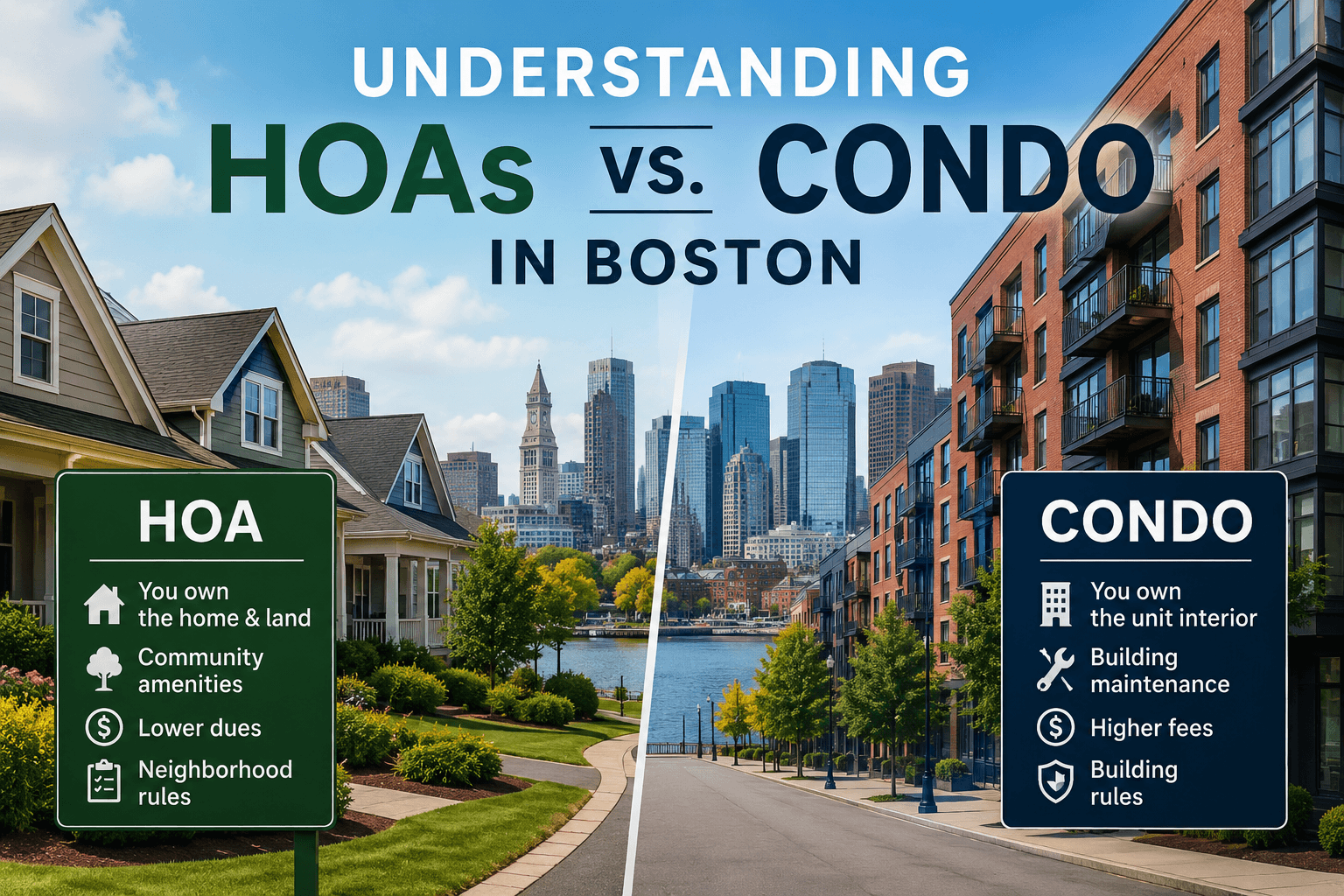
If you own property in Boston, you have probably heard the terms “HOA” and “condo association” used as if they mean the same thing. They don’t. Many local owners—and even some board members—are surprised to learn that these two structures carry different ownership rights, different maintenance duties, and different financial obligations. Both manage shared responsibilities, but the way they do it can affect your wallet, your weekends, and your long-term property value. Understanding the differences between HOAs and condo associations helps owners, board members, and buyers make smarter decisions before they sign a purchase agreement, cast a board vote, or set next year’s budget.
This guide breaks it down in plain language for Boston and Massachusetts property owners.
Key Takeaway: An HOA usually governs owners who each own their home and the land beneath it, while a condo association governs owners who own the interior of their unit and share ownership of the building and common areas. In condo-heavy Boston, most shared-housing communities are condo associations—which means the association is responsible for major building systems like roofs, elevators, hallways, and exteriors.
What Is an HOA?
A homeowners association, or HOA, is an organization that governs a planned community and the property owners who live in it. HOAs are most commonly found in planned developments, subdivisions, townhome communities, and neighborhoods with shared amenities. When you buy a home within one of these communities, you automatically become a member of the HOA and agree to follow its rules.
Typical HOA board responsibilities include enforcing community rules, maintaining shared common areas such as private roads or green space, managing amenities like pools and clubhouses, collecting dues, and overseeing architectural guidelines that keep the neighborhood consistent. In short, an HOA focuses on the community around your home rather than the structure of the home itself.
What Is a Condo Association?
A condominium (condo) association governs a multi-unit property where owners share a building and its common elements. Instead of standalone homes on separate lots, you have individual units stacked or connected within one or more structures. The association exists to maintain everything the owners share and to keep the building running smoothly.
This model is especially important in Boston, where the housing market is heavily made up of condos—from triple-deckers in Dorchester and Jamaica Plain to brownstones in the Back Bay and high-rises downtown. Typical condo board responsibilities include building maintenance; roof, hallway, elevator, and exterior upkeep; insurance coordination through a master policy; building and managing reserve funds; handling common-area repairs; and managing vendor contracts for services like landscaping, cleaning, and snow removal. Because the association maintains the structure itself, the stakes—and the budgets—tend to be higher than in many HOAs.
Key Differences Between HOAs and Condo Associations
The core differences between HOAs and condo associations come down to what you own and who is responsible for maintaining it. The table below offers a simple side-by-side comparison.
| Feature | HOA | Condo Association |
|---|---|---|
| Property ownership | Owner owns the home and the land it sits on | Owner owns the interior of the unit; shares ownership of the building |
| Common area responsibility | Shared spaces like roads, parks, and amenities | Building structure, hallways, roof, exterior, and grounds |
| Maintenance duties | Owner maintains their own home and yard | Association maintains the building; owner maintains unit interior |
| Fees | HOA dues, often lower | Condo fees, often higher due to structural upkeep |
| Rules and restrictions | Architectural and community guidelines | Building rules, noise, alterations, and use of common areas |
| Insurance | Owner insures their full home and property | Association holds a master policy; owner insures the unit interior |
| Board responsibilities | Community standards and shared amenities | Structural maintenance, reserves, and vendor management |
Ownership Structure: What Do You Actually Own?
Ownership is the clearest dividing line. In an HOA community, you typically own your individual home and the land underneath it. You are responsible for your roof, your walls, and your yard, while the HOA handles the shared spaces around you.
In a condo association, you usually own the inside of your unit—the space from the walls in—while the building structure and common areas are owned collectively by all unit owners. For Boston buyers, this is a practical detail that matters at closing: if you are purchasing a condo, the association, not you alone, is responsible for the roof over your head and the systems that keep the building standing. Knowing this helps you ask the right questions about the association’s health before you buy.
Fees and Assessments: How Costs Are Handled
Both structures collect regular payments, but they often look different. HOA dues tend to cover community upkeep and amenities, while condo fees frequently run higher because the association is maintaining the building itself—structural elements, shared systems, and exterior work that protect everyone’s investment.
Sometimes regular fees are not enough to cover a large or unexpected expense. When that happens, a board may issue a special assessment—a one-time charge to owners to fund a specific project. In Boston, special assessments often relate to snow removal during heavy winters, roof repairs on aging buildings, elevator maintenance, masonry work on older brick structures, and other upkeep that comes with the city’s historic housing stock. Healthy reserve funds and good budgeting reduce how often these surprises land on owners.
Rules, Bylaws, and Governance
Both HOAs and condo associations operate under governing documents—typically a declaration or master deed, bylaws, and a set of rules and regulations. These documents spell out what owners can and cannot do, how fees are set, and how the board makes decisions. In Massachusetts, condominiums are also governed by state condominium law (Massachusetts General Laws Chapter 183A), which shapes how associations are formed and operated.
Both rely on an elected board of owners to make decisions on behalf of the community, but their day-to-day focus differs: an HOA board may spend more time on community standards and amenities, while a condo board often deals with building systems, contractors, and reserves. In either case, clear communication and consistent management go a long way toward preventing disputes and keeping owners on the same page.
Why the Difference Matters in Boston
Boston brings its own challenges that make the HOA-versus-condo distinction especially relevant. The city is full of older buildings with aging roofs, brick facades, and shared heating systems that require ongoing attention. Neighborhoods are dense, units sit close together, and many buildings share walls, entryways, and utilities. Add long New England winters—with snow removal, ice dams, and seasonal maintenance—plus tight parking and limited outdoor space, and you have communities that demand careful, disciplined budgeting.
For most Boston condo associations, that means structural upkeep and reserve planning are not optional extras—they are central to protecting the building and every owner’s investment. Understanding which entity you belong to, and what it is responsible for, helps you plan realistically.
When Should an HOA or Condo Association Hire Professional Management?
Many associations start out self-managed, with volunteer board members handling everything themselves. That can work for a while, but certain warning signs suggest it may be time to bring in professional help. Watch for delayed or deferred maintenance, poor financial tracking, a rising number of owner complaints, trouble managing vendors, unclear or inconsistent communication, difficulty enforcing the rules fairly, and reserve planning that keeps getting pushed off.
When these issues pile up, they can lead to bigger expenses and frustrated owners. This is where a professional community association management partner can lighten the load, bringing structure and experience to a board that is stretched thin. Green Ocean AM works with Boston associations to handle exactly these challenges so volunteer boards are not left managing complex buildings alone.
How Green Ocean AM Helps Boston Associations
Green Ocean AM provides condo association management and HOA management services built around the realities of Boston-area properties. Our goal is to make boards’ lives easier while protecting the long-term health of the community. Services include financial management and transparent budgeting, vendor coordination, maintenance oversight, board support, clear owner communication, compliance assistance, and long-term reserve and capital planning.
Every building is different, and good management starts with understanding your community’s specific needs rather than applying a one-size-fits-all formula. If your board is feeling stretched, you can reach out to Green Ocean AM for a no-pressure conversation about how professional management could support your association. You can also review our management pricing to see what fits your community.
FAQs About HOAs and Condo Associations in Boston
Is an HOA the same as a condo association?
No. Both manage shared responsibilities, but an HOA typically governs owners who own their home and land, while a condo association governs owners who own their unit interior and share the building and common areas.
Are condo association fees usually higher than HOA fees?
Often, yes. Condo associations maintain the building structure—roofs, elevators, hallways, and exteriors—so their fees frequently cover more shared costs than typical HOA dues.
Who is responsible for repairs in a condo association?
Generally, the association is responsible for the building structure and common areas, while individual owners are responsible for the interior of their own unit. Your governing documents spell out the exact dividing line.
Can an HOA or condo association enforce rules?
Yes. Both have governing documents and bylaws that allow the board to enforce rules, and they can apply fines or other remedies when owners do not comply, as long as they follow the proper process.
Do Boston condo associations need professional management?
Not always, but many benefit from it. Older buildings, complex maintenance, reserve planning, and seasonal demands can be a lot for volunteer boards, and professional management helps keep finances and upkeep on track.
What should board members look for in an association management company?
Look for local experience, transparent financial reporting, strong communication, reliable vendor relationships, knowledge of Massachusetts condominium laws, and a collaborative approach that supports—rather than replaces—your board.
Conclusion
The differences between HOAs and condo associations come down to ownership, responsibility, and cost. HOA owners generally own their home and land and share community amenities, while condo owners own their unit interior and share the building and its major systems—a distinction that carries real weight in condo-heavy Boston. Knowing which one governs your property helps you budget wisely, follow the right rules, and protect your investment.
If your Boston HOA or condo association board could use a hand managing finances, maintenance, or owner communication, Green Ocean AM is here to help. Contact us to learn how professional association management can keep your community running smoothly all year long.